Secondary matter, not salvation. But the plain text of Scripture describes something very different from what you were taught.
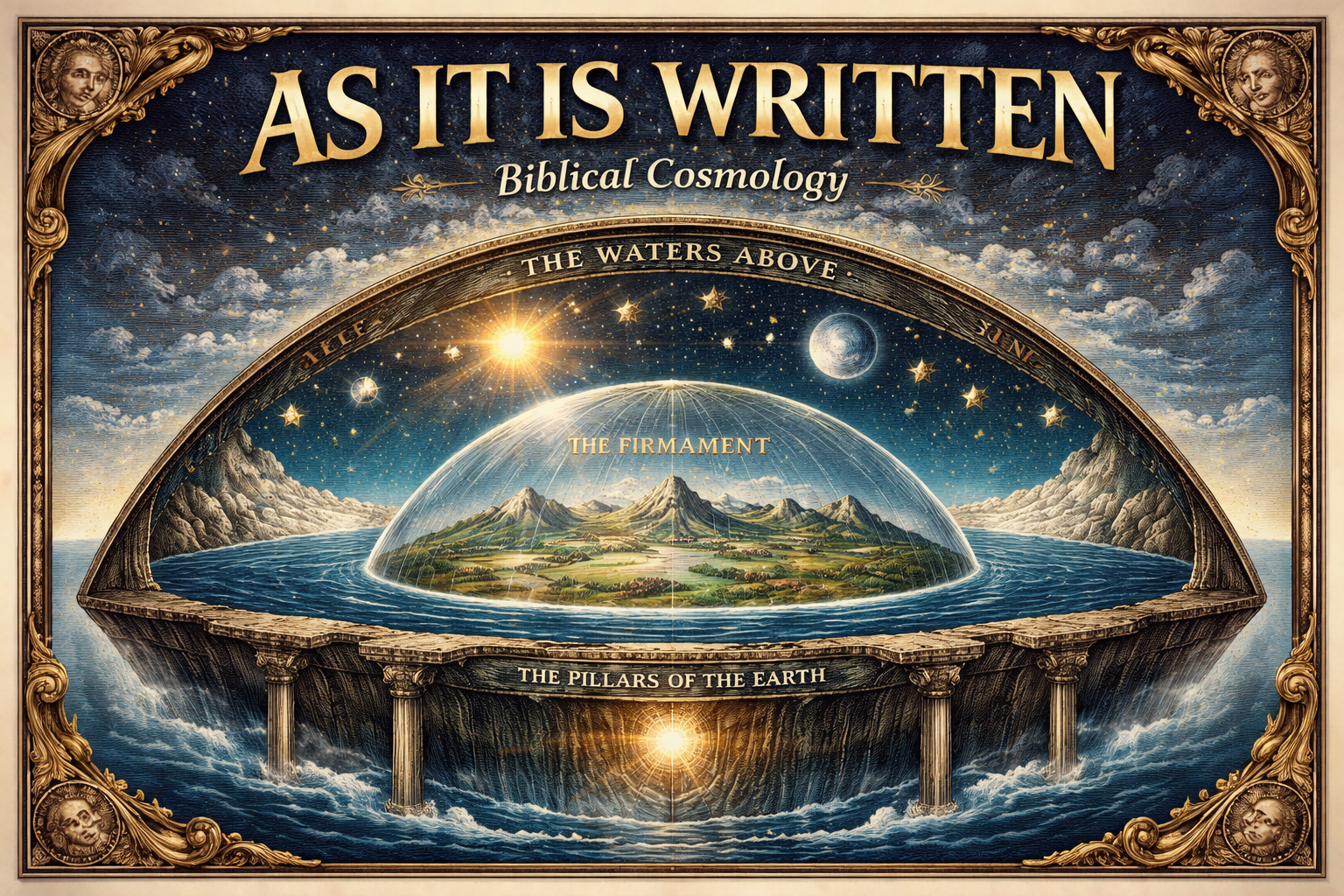
This is a secondary matter distinct from salvation. We hold these positions based on the plain text of Scripture. We do not divide over cosmology. We do not make this a test of fellowship. We simply present what the text says and allow the reader to decide.
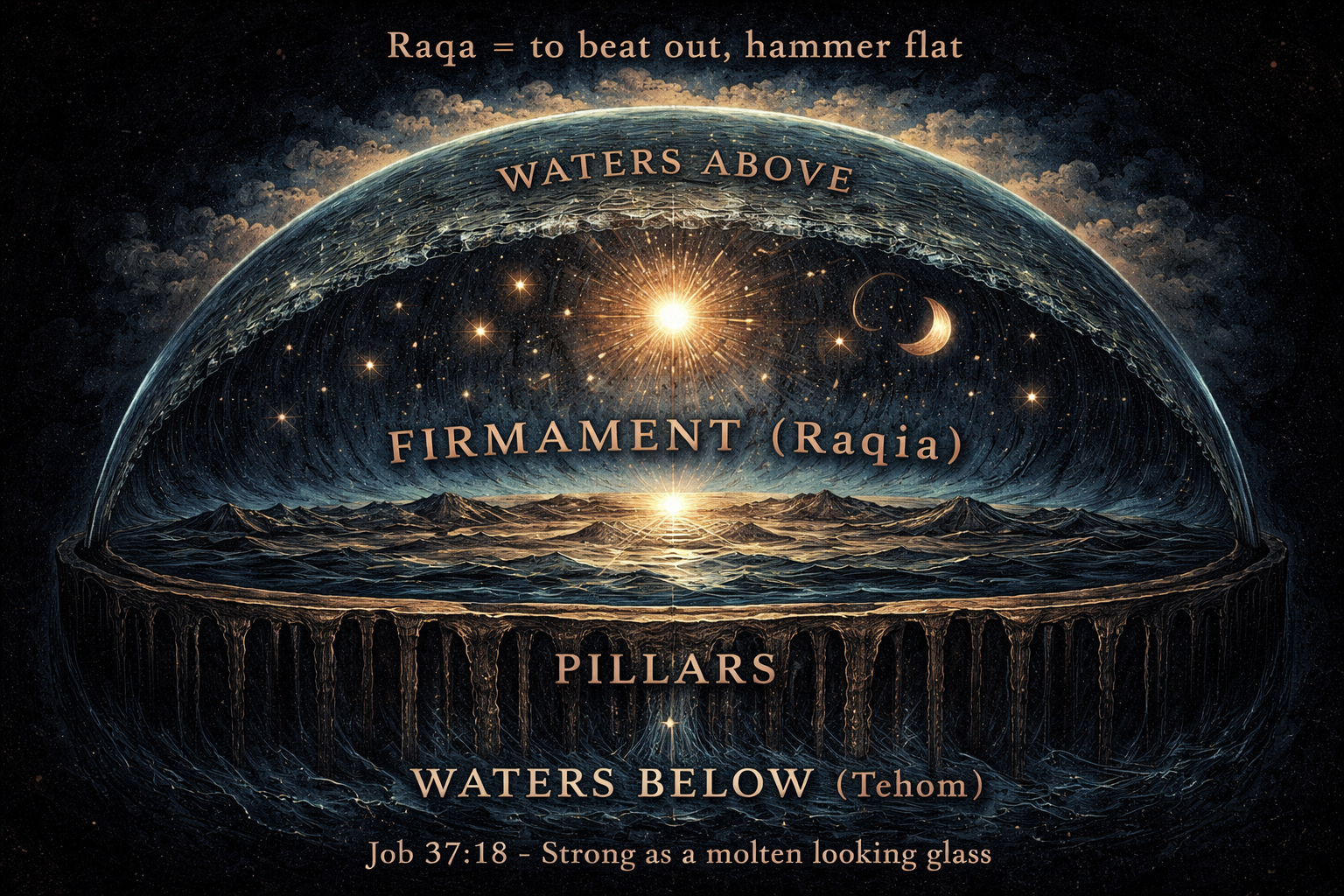
The Hebrew word translated "firmament" is raqia, derived from the verb raqa, which means to beat out, hammer flat, stamp, or spread by beating. It is metalworking language. The same word is used for hammering out gold into thin sheets (Exodus 39:3) and for stamping with the feet (Ezekiel 6:11).
"And Elohim said, Let there be a firmament in the midst of the waters, and let it divide the waters from the waters. And Elohim made the firmament, and divided the waters which were under the firmament from the waters which were above the firmament."
Genesis 1:6-7 -- The firmament separates waters above from waters below.
"Hast thou with him spread out the sky, which is strong, and as a molten looking glass?"
Job 37:18 -- The sky is described as strong and like a cast metal mirror.
"And the likeness of the firmament upon the heads of the living creature was as the colour of the terrible crystal, stretched forth over their heads above."
Ezekiel 1:22 -- The firmament appears crystalline.
"And above the firmament that was over their heads was the likeness of a throne, as the appearance of a sapphire stone: and upon the likeness of the throne was the likeness as the appearance of a man above upon it."
Ezekiel 1:26 -- The throne of the Most High is ABOVE the firmament.
"The heavens declare the glory of Elohim; and the firmament sheweth his handywork."
Psalm 19:1
"Praise him, ye heavens of heavens, and ye waters that be above the heavens."
Psalm 148:4 -- Waters above the heavens still exist. This is not a past-tense description.
Four witnesses in Scripture declare that the earth does not move. These are not poetry about emotional stability. They are cosmological statements embedded in hymns of praise about the physical creation.
"Fear before him, all the earth: the world also shall be stable, that it be not moved."
1 Chronicles 16:30
"Yahuah reigneth, he is clothed with majesty; Yahuah is clothed with strength, wherewith he hath girded himself: the world also is stablished, that it cannot be moved."
Psalm 93:1
"Say among the heathen that Yahuah reigneth: the world also shall be established that it shall not be moved."
Psalm 96:10
"Who laid the foundations of the earth, that it should not be removed for ever."
Psalm 104:5
In Torah, a matter is established by two or three witnesses (Deuteronomy 19:15). Here we have four separate declarations that the earth is fixed and immovable. The Hebrew word used is mot -- to waver, slip, shake, be moved. The text says the earth does NOT do this.
Yahuah describes the creation of the earth using construction language -- foundations, pillars, cornerstones, and measurements. These are architectural terms for a structure, not descriptions of a spinning ball.
"Where wast thou when I laid the foundations of the earth? declare, if thou hast understanding. Who hath laid the measures thereof, if thou knowest? or who hath stretched the line upon it? Whereupon are the foundations thereof fastened? or who laid the corner stone thereof?"
Job 38:4-6 -- Foundations, measurements, a building line, foundations fastened, a cornerstone. This is construction language.
"For the pillars of the earth are Yahuah's, and he hath set the world upon them."
1 Samuel 2:8
"Which shaketh the earth out of her place, and the pillars thereof tremble."
Job 9:6
"The earth and all the inhabitants thereof are dissolved: I bear up the pillars of it. Selah."
Psalm 75:3
When Scripture describes the creation of the earth, it consistently uses the language of spreading -- as in spreading out a sheet, a tent, or a hammered surface. Never rolling into a ball.
"Thus saith El Yahuah, he that created the heavens, and stretched them out; he that spread forth the earth [raqa], and that which cometh out of it."
Isaiah 42:5 -- The same verb (raqa) used for the firmament is used for the earth.
"Thus saith Yahuah, thy redeemer, and he that formed thee from the womb, I am Yahuah that maketh all things; that stretcheth forth the heavens alone; that spreadeth abroad the earth by myself."
Isaiah 44:24
"To him that stretched out the earth above the waters: for his mercy endureth for ever."
Psalm 136:6 -- The earth is stretched out ABOVE the waters, not floating in space.
"Hast thou perceived the breadth of the earth? declare if thou knowest it all."
Job 38:18 -- Breadth implies extension, not curvature. A ball has circumference, not breadth.
"It is he that sitteth upon the circle of the earth, and the inhabitants thereof are as grasshoppers; that stretcheth out the heavens as a curtain, and spreadeth them out as a tent to dwell in." Isaiah 40:22
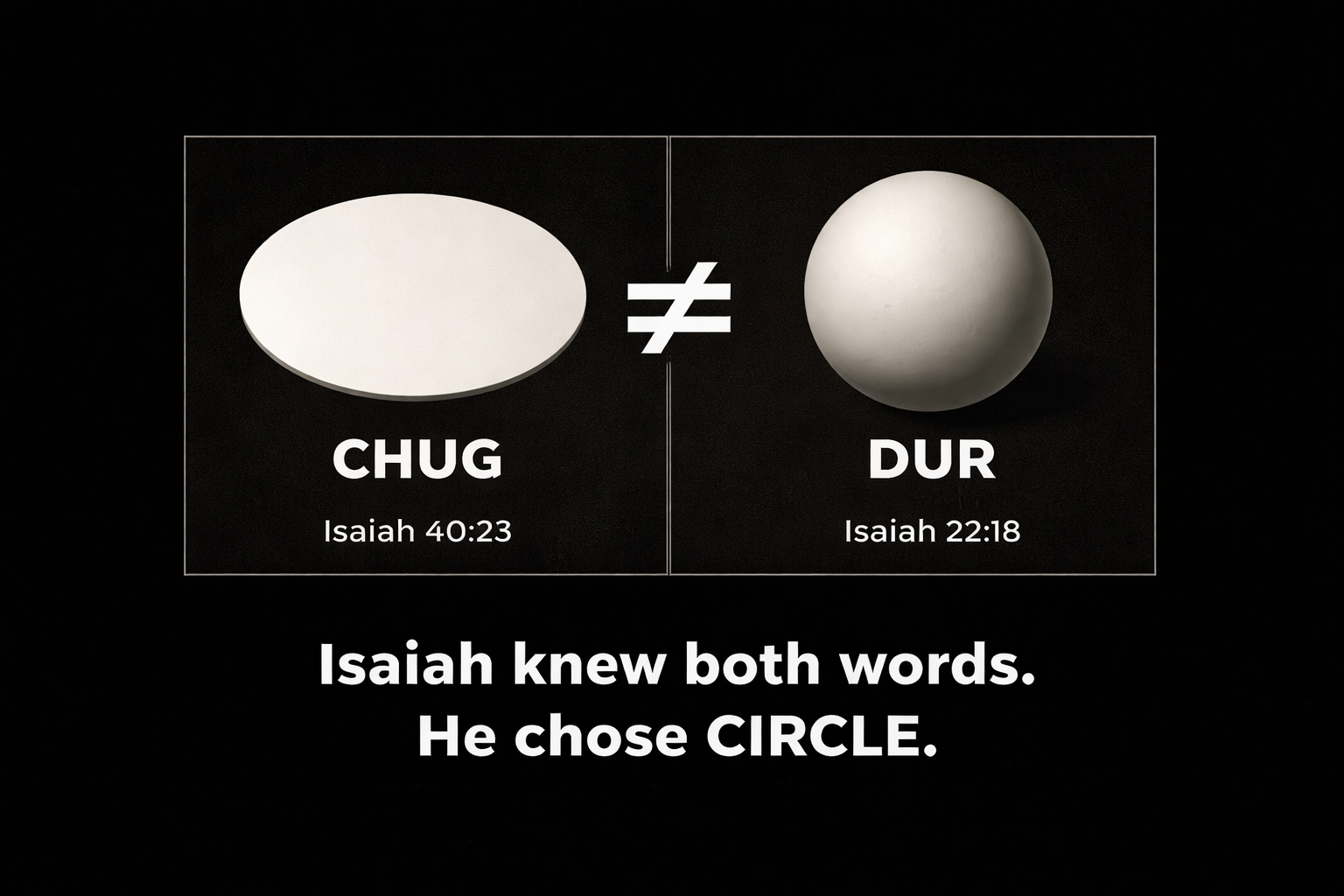
Many claim this verse proves a spherical earth. But the Hebrew word used here is chug, which means circle, circuit, or compass. It is a flat, two-dimensional word.
Isaiah knew the Hebrew word for ball. He used it two chapters earlier:
"He will surely violently turn and toss thee like a ball into a large country." Isaiah 22:18
Isaiah 40:22
Circle, circuit, compass
2D -- flat circle
Isaiah 22:18
Ball, sphere
3D -- sphere/ball
Isaiah had both words available. He chose chug (circle) for the earth and used dur (ball) elsewhere. If the earth were a sphere, why would Isaiah -- writing under the inspiration of the Ruach HaQodesh -- choose the word for a flat circle when the word for a ball was in his vocabulary?
In the modern model, the earth rotates and orbits the sun. In Scripture, the sun moves across the sky above a stationary earth. The language is not ambiguous.
"Then spake Joshua to Yahuah in the day when Yahuah delivered up the Amorites before the children of Israel, and he said in the sight of Israel, Sun, stand thou still upon Gibeon; and thou, Moon, in the valley of Ajalon. And the sun stood still, and the moon stayed, until the people had avenged themselves."
Joshua 10:12-13 -- The sun and moon were commanded to stop. Something that is moving must stop. If the earth rotates, Joshua should have commanded the earth to stop.
"The sun also ariseth, and the sun goeth down, and hasteth to his place where he arose."
Ecclesiastes 1:5 -- The sun has a circuit. It hastens back to its starting point.
"Their line is gone out through all the earth, and their words to the end of the world. In them hath he set a tabernacle for the sun, which is as a bridegroom coming out of his chamber, and rejoiceth as a strong man to run a race. His going forth is from the end of the heaven, and his circuit unto the ends of it."
Psalm 19:4-6 -- The sun runs a race. It has a going forth and a circuit. The sun moves.
"Behold, I will bring again the shadow of the degrees, which is gone down in the sun dial of Ahaz, ten degrees backward. So the sun returned ten degrees."
2 Kings 20:11 -- The sun moved backward. The text says the sun returned, not that the earth reversed its rotation.
"The sun and moon stood still in their habitation."
Habakkuk 3:11 -- Again: the sun and moon are the objects that stop.
A sphere has no ends, no edges, no corners. Yet Scripture repeatedly describes the earth as having all three.
"For he looketh to the ends of the earth, and seeth under the whole heaven."
Job 28:24
"Hast thou not known? hast thou not heard, that the everlasting Elohim, Yahuah, the Creator of the ends of the earth, fainteth not, neither is weary?"
Isaiah 40:28
"Thou whom I have taken from the ends of the earth, and called thee from the chief men thereof."
Isaiah 41:9
"O Yahuah, my strength, and my fortress, and my refuge in the day of affliction, the Gentiles shall come unto thee from the ends of the earth."
Jeremiah 16:19
"And after these things I saw four angels standing on the four corners of the earth, holding the four winds of the earth."
Revelation 7:1 -- Four corners. Four angles. A sphere has none.
"And Elohim said, Let there be lights in the firmament of the heaven to divide the day from the night; and let them be for signs, and for seasons, and for days, and years: And let them be for lights in the firmament of the heaven to give light upon the earth: and it was so. And Elohim made two great lights; the greater light to rule the day, and the lesser light to rule the night: he made the stars also. And Elohim set them in the firmament of the heaven to give light upon the earth." Genesis 1:14-17
Three times in four verses, the text says the luminaries are in the firmament. Not beyond it. Not millions of miles past it. In it. The sun, moon, and stars are placed within the solid structure of the firmament, like lights set into a ceiling.
The Hebrew preposition used is b (bet), meaning "in" or "within." Not al (above) or me'al (beyond). The luminaries are embedded in the firmament.
"I do set my bow in the cloud, and it shall be for a token of a covenant between me and the earth. And it shall come to pass, when I bring a cloud over the earth, that the bow shall be seen in the cloud." Genesis 9:13-14
A rainbow always appears as a consistent arc -- the same shape from any vantage point. This is consistent with light refracting against a curved, dome-shaped surface. The bow is "set in the cloud" -- placed against the canopy.
Ezekiel saw the same structure around the throne: "As the appearance of the bow that is in the cloud in the day of rain, so was the appearance of the brightness round about" (Ezekiel 1:28). The rainbow pattern reflects the dome architecture.
Our atmosphere is a pressurized system. At sea level, the air pressure is approximately 14.7 pounds per square inch (PSI). This pressure is what allows us to breathe, what keeps water liquid, and what enables life as we know it.
In the modern model, this pressurized atmosphere sits directly adjacent to the vacuum of outer space -- a near-perfect vacuum with essentially zero pressure. The transition zone (thermosphere/exosphere) is described as a gradual thinning.
A pressurized system adjacent to a vacuum requires a container. This is basic physics. Every pressurized system ever built by man -- from tires to spacecraft to diving bells -- requires a sealed boundary. Gas always moves from high pressure to low pressure until equilibrium is reached.
The firmament described in Scripture IS that container. A solid, hammered-out structure (raqia) separating the pressurized atmosphere from whatever lies beyond. Without a physical barrier, the atmosphere would dissipate into the vacuum.
Scripture describes the container. Physics requires the container. The only question is whether you accept the description.
We present these passages not to divide, but to invite honest examination. The plain text of Scripture describes a cosmology that is internally consistent across Genesis, Job, Psalms, Isaiah, Ezekiel, and Revelation. Dozens of passages, multiple authors, spanning thousands of years -- all describing the same structure: a fixed earth, a solid firmament, luminaries within it, waters above and below, foundations, pillars, ends, and edges.
Whether you accept this cosmology or not, you cannot honestly say "the Bible doesn't describe this." It does. The question is whether you take the text at face value or reinterpret it to match a different model.