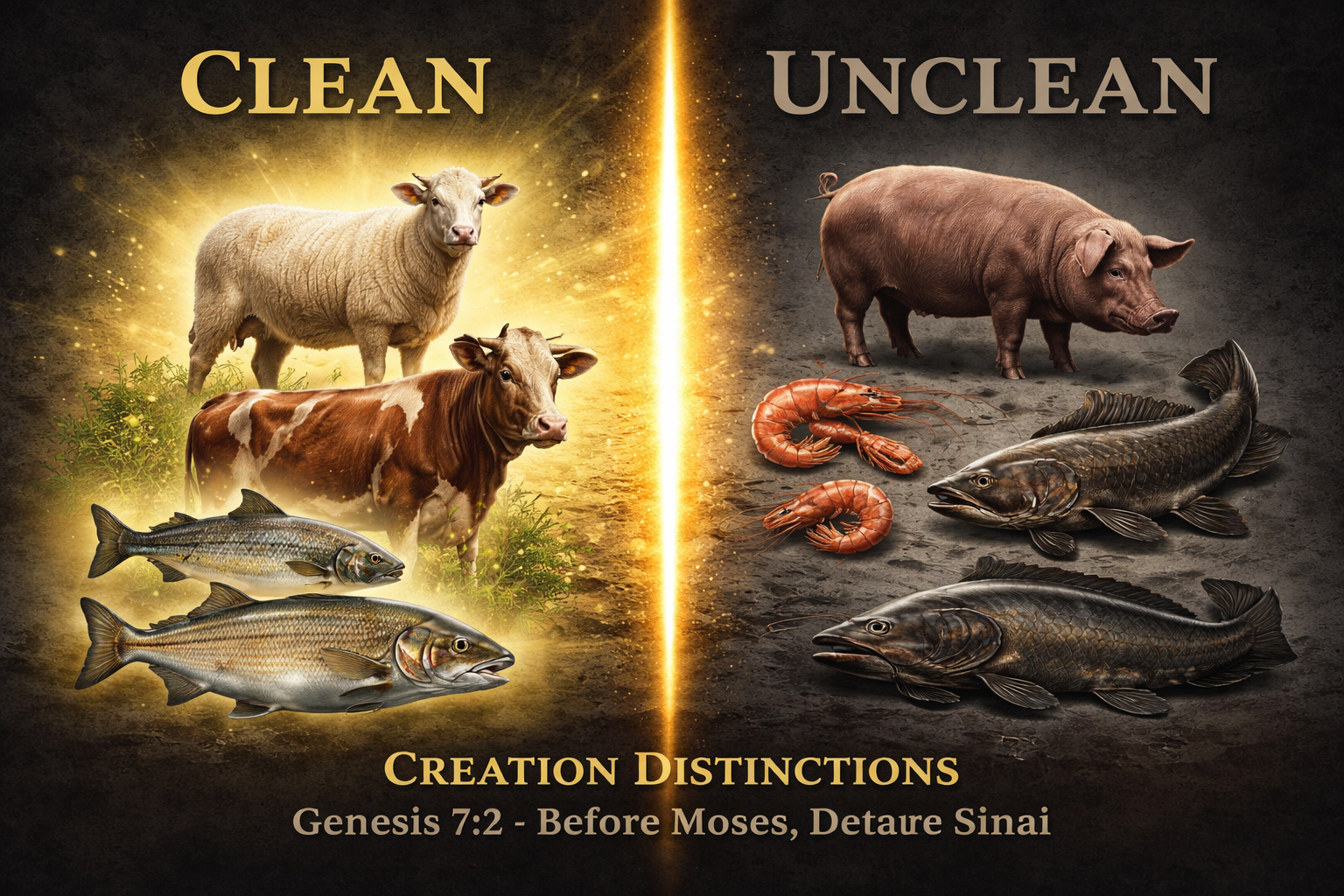
Creation distinctions, not ceremonial law. Noah knew clean from unclean before Sinai.
The most common argument against dietary laws is that they were "Mosaic ceremonial law" given only to Israel and abolished at the execution stake. But Scripture destroys this argument in one verse:
"They that sanctify themselves, and purify themselves in the gardens behind one tree in the midst, eating swine's flesh, and the abomination, and the mouse, shall be consumed together, saith Yahuah." Isaiah 66:17
This is an end-times prophecy. Yahuah is warning about the destruction of those eating unclean animals at the end of days. If dietary laws were abolished, why is He bringing judgment for violating them at His return? The answer is clear: they were never abolished.
The basic principles of clean and unclean are straightforward:
These are not arbitrary rules. They reflect the Creator's design. Unclean animals are the sanitation crew of the earth -- bottom feeders, scavengers, and filter systems. They were designed to clean the environment, not to be consumed as food.
Mark 7 is the most commonly cited passage to argue that Yahusha declared all foods clean. But reading the actual context tells a completely different story.
Modern translations add a parenthetical statement at the end of Mark 7:19 that reads: "(In saying this, Jesus declared all foods clean.)" or similar. This is a translator's addition -- it is not in the original Greek text.
Compare the King James Version (which follows the Greek more closely):
"Because it entereth not into his heart, but into the belly, and goeth out into the draught, purging all meats?" Mark 7:19 (KJV)
The KJV translates this as a statement about digestion -- food passes through the body. The parenthetical "declaring all foods clean" found in NIV, ESV, and other modern translations is an editorial interpretation, not a translation of the Greek text. Translators inserted their theological conclusion into Scripture.
Acts 10 records the vision of the sheet with unclean animals that Peter saw. It is the second most misused passage to argue that dietary laws were abolished. But Peter himself tells us exactly what the vision meant -- and it has nothing to do with food.
Peter saw a sheet descending from heaven filled with all kinds of unclean animals. A voice said, "Rise, Peter; kill, and eat." Peter refused:
"But Peter said, Not so, Master; for I have never eaten any thing that is common or unclean." Acts 10:14
Peter said "NEVER." This is approximately 10 years after Mark 7. If Yahusha had declared all foods clean in Mark 7, Peter -- who was present for that teaching -- would have known. But a decade later, Peter says he has never eaten anything unclean.
Either Peter was disobeying a direct command from the Messiah for 10 years, or Yahusha never declared all foods clean. The answer is obvious.
After the vision, Peter did not go to a marketplace and buy pork. He went to a Gentile's house. And he explained the vision himself:
"And he said unto them, Ye know how that it is an unlawful thing for a man that is a Yahudi to keep company, or come unto one of another nation; but Elohim hath shewed me that I should not call any MAN common or unclean." Acts 10:28
Peter interpreted the vision himself, under the inspiration of the Set-Apart Spirit: the vision was about people, not food. The unclean animals represented the Gentiles, whom the Yahudim considered unclean. Yahuah was telling Peter that the gospel was for all nations, not just Israel.
The dietary laws of Scripture are not ceremonial. They are not Mosaic. They are creation-level distinctions that predate Sinai by over a millennium. Noah knew them. Abraham knew them. Israel codified them. Yahusha kept them. Peter kept them. And Isaiah prophesied judgment against those who violate them at the end of days.
Mark 7 is about handwashing, not food. Acts 10 is about people, not animals. The two passages most commonly used to abolish dietary laws, when read in context, actually confirm that the early believers still observed them.