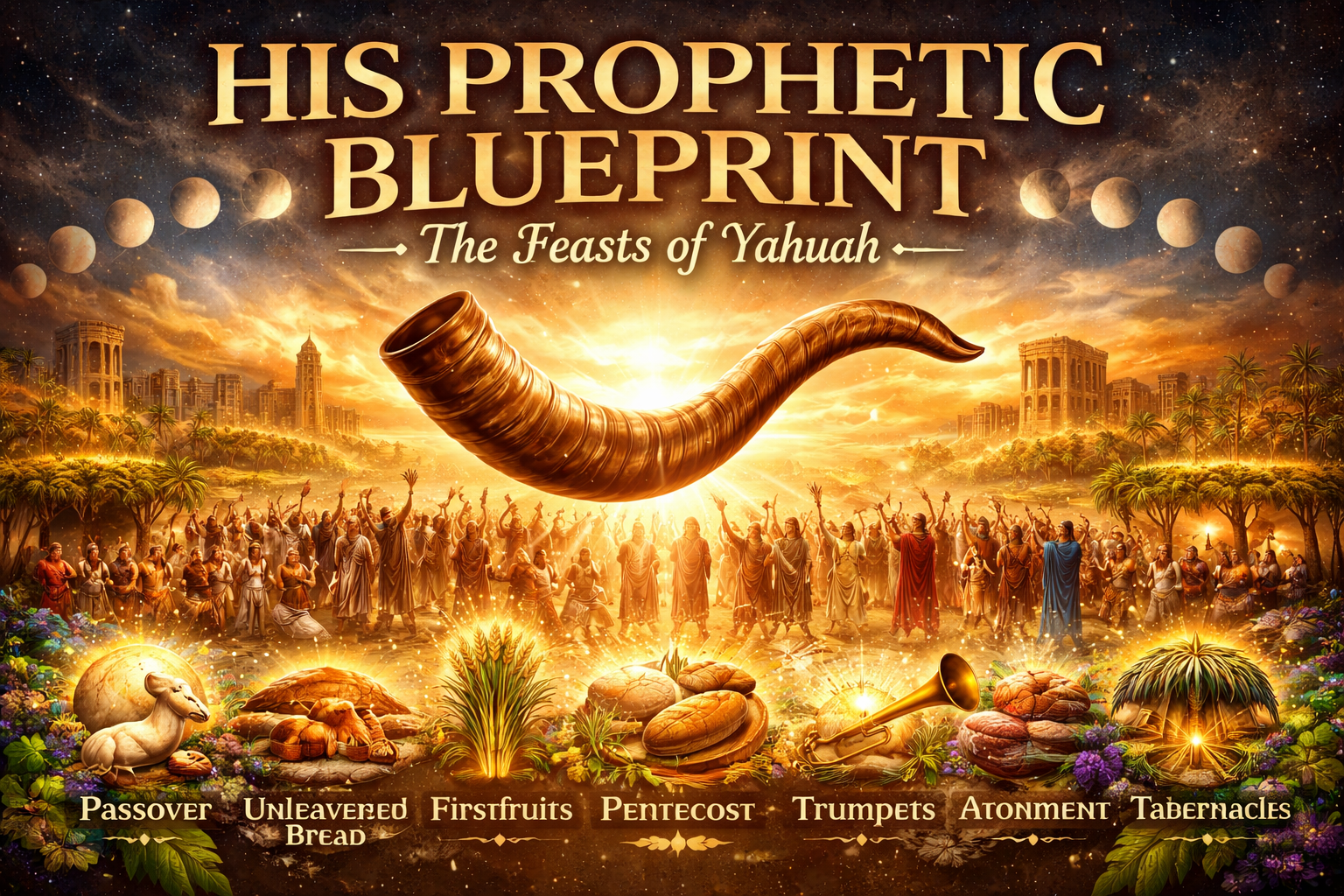
These are Yahuah's feasts. Not Jewish feasts. Not Israel's feasts. His. And they map His entire plan.
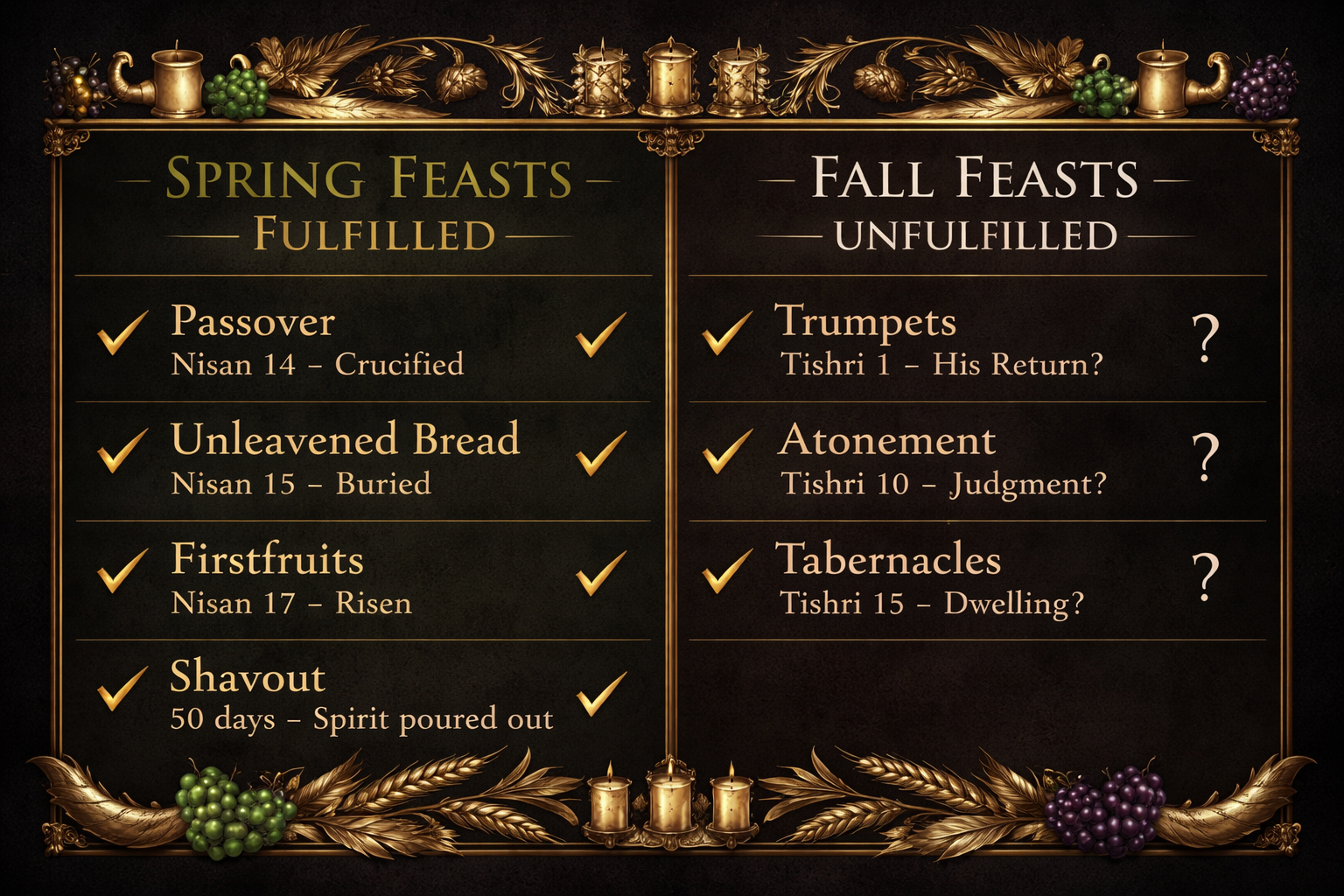
Leviticus 23 does not call these "Jewish feasts" or "Israel's feasts." The text says: "These are the feasts of Yahuah." They belong to Him. They are His appointed times — His moedim — fixed appointments on His calendar. And the spring feasts were fulfilled with terrifying precision.
| Feast | Date | Prophetic Fulfillment | Scripture |
|---|---|---|---|
| Passover (Pesach) | Nisan 14 | Yahusha crucified — the Lamb slain | 1 Corinthians 5:7 |
| Unleavened Bread (Matzot) | Nisan 15 | His sinless body buried — no corruption | Acts 2:31 |
| Firstfruits (Bikkurim) | Nisan 17 | Resurrection — firstfruits from the dead | 1 Corinthians 15:20-23 |
| Shavuot (Pentecost) | 50 days later | The Ruach HaQodesh poured out | Acts 2:1-4 |
Four feasts. Four fulfilled to the exact calendar day. Not approximately. Not within the same week. Not in the same season. To the day. Passover lamb slain on Passover. Sinless body buried on Unleavened Bread. Resurrection on Firstfruits. Spirit poured out on Shavuot — exactly fifty days later.
This is not coincidence. This is a blueprint. And once you see the pattern, the fall feasts become impossible to ignore.
| Feast | Date | Prophetic Fulfillment | Scripture |
|---|---|---|---|
| Yom Teruah (Trumpets) | Tishri 1 | His return — the last trumpet sounds | 1 Thess 4:16, 1 Cor 15:52, Matt 24:31, Rev 11:15 |
| Yom Kippur (Atonement) | Tishri 10 | Final judgment — the nations stand before Him | Matt 25:31-46 |
| Sukkot (Tabernacles) | Tishri 15 | He dwells with His people — Tabernacles fulfilled | Rev 21:3, Zech 14:16-19 |
"For the Master himself shall descend from heaven with a shout, with the voice of the archangel, and with the trump of Elohim: and the dead in Messiah shall rise first."
1 Thessalonians 4:16
Yom Teruah is the Feast of Trumpets. The last trump sounds. He descends.
"When the Son of man shall come in his glory, and all the set-apart messengers with him, then shall he sit upon the throne of his glory: And before him shall be gathered all nations: and he shall separate them one from another."
Matthew 25:31-32
Yom Kippur — the Day of Atonement — is the day of judgment. The nations are weighed.
"And I heard a great voice out of heaven saying, Behold, the tabernacle of Elohim is with men, and he will dwell with them, and they shall be his people, and Elohim himself shall be with them."
Revelation 21:3
Sukkot means "tabernacles" or "booths." He will literally tabernacle with His people. The feast fulfilled.
Matthew 24:36 is the verse most often used to shut down prophetic inquiry: "But of that day and hour knows no man, no, not the angels of heaven, but my Father only."
Modern Christianity reads this as: "Stop looking. You can never know. Don't even try." But first-century Hebrew ears heard something entirely different.
"The day and hour no man knows" is a well-known Hebrew idiom for Yom Teruah — the Feast of Trumpets. Here is why:
There is a genuine layer to this as well. He truly did not know the exact moment the new moon would be sighted — that knowledge belonged to the Father alone. But He pointed His disciples directly to the feast. The idiom and the literal truth overlap perfectly.
"But you, brothers, are not in darkness, that that day should overtake you as a thief. You are all the children of light."
1 Thessalonians 5:4-5
Paul confirms it: we are NOT supposed to be caught off guard. If it were truly unknowable, why would Paul say this?
The Book of Revelation repeatedly states that Babylon falls in "one hour." This phrase appears three times for emphasis:
"And the ten horns which you saw are ten kings, which have received no kingdom as yet; but receive power as kings one hour with the beast."
Revelation 17:12
"Alas, alas, that great city Babylon, that mighty city! For in one hour is your judgment come."
Revelation 18:10
"For in one hour so great riches is come to nothing."
Revelation 18:17
If the fall feasts follow the same literal, sequential, to-the-day pattern as the spring feasts, the end-times timeline maps onto a precise 15-day window:
Fifteen days. One prophetic hour. Three feasts. The entire culmination of human history compressed into a window so precise that the blueprint was written three thousand years ago in Leviticus 23.
"After two days will he revive us: in the third day he will raise us up, and we shall live in his sight."
Hosea 6:2
"But, beloved, be not ignorant of this one thing, that one day is with Yahuah as a thousand years, and a thousand years as one day."
2 Peter 3:8
If one day with Yahuah equals a thousand years, then Hosea 6:2 becomes a prophetic timeline:
Two days. Two thousand years. The math is plain. The prophecy is specific. And the timeline converges on the same window that every other prophetic thread points to.
"And it shall come to pass, that every one that is left of all the nations which came against Jerusalem shall even go up from year to year to worship the King, Yahuah of hosts, and to keep the feast of tabernacles."
Zechariah 14:16
"And it shall be, that whoso will not come up of all the families of the earth unto Jerusalem to worship the King, Yahuah of hosts, even upon them shall be no rain."
Zechariah 14:17
This is the millennial kingdom. After Yahusha's return. After the judgment. After Babylon falls. And the nations are still keeping the Feast of Tabernacles. Not as a suggestion. As a requirement. With consequences for disobedience.
If the feasts were "done away with at the cross," why are they mandated in the age to come? If they are "Jewish" and irrelevant to believers, why are all nations — not just Israel — required to observe them?
The feasts were never abolished. They were never "fulfilled and therefore finished." Spring feasts were fulfilled — and still picture His work. Fall feasts are not yet fulfilled — and still await their appointed time.
If four spring feasts were fulfilled to the exact calendar day at His first coming, and three fall feasts remain unfulfilled, and those feasts are still observed in the millennial kingdom...
...on what basis do you ignore them?
These are not suggestions. They are not cultural relics. They are the prophetic blueprint of the Most High, written in Leviticus 23, confirmed by Yahusha's death and resurrection, and still binding when He reigns from Jerusalem.
The feasts are the map. And the map says the destination is close.