Not tradition. Not denomination. Not creed. Not council. Not pastor. Not seminary. The Word.
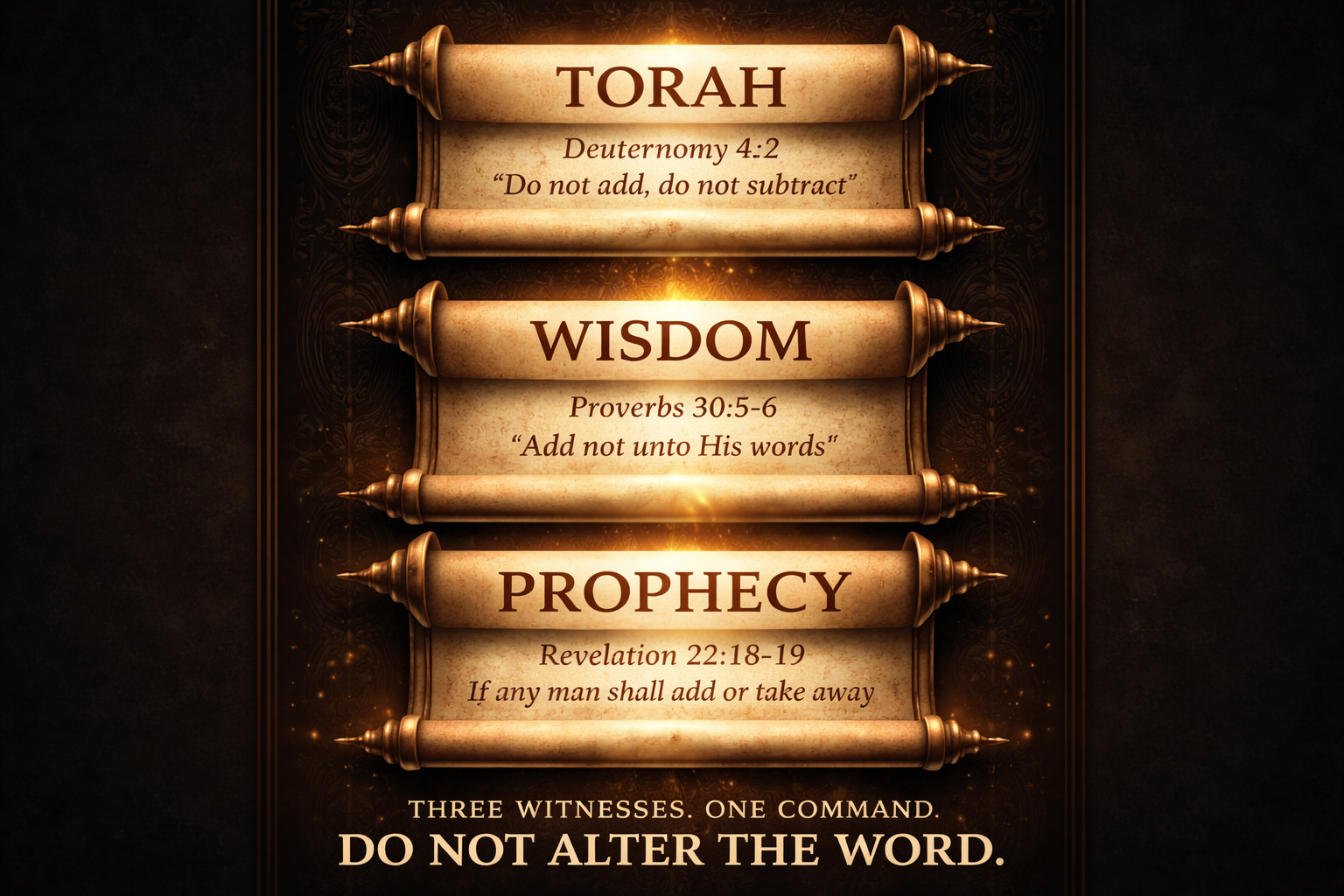
Three witnesses across Torah, Wisdom, and Prophecy. All saying the same thing. Do not add. Do not subtract.
"You shall not ADD unto the word which I command you, neither shall you DIMINISH ought from it, that you may keep the commandments of Yahuah your Elohim which I command you."
Deuteronomy 4:2 — Torah
The first witness. Given through Moses at Sinai. The standard is set from the beginning.
"Every word of Elohim is pure: He is a shield unto them that put their trust in Him. ADD THOU NOT unto His words, lest He reprove thee, and thou be found a liar."
Proverbs 30:5-6 — Wisdom
The second witness. Adding to His words makes you a liar. Not mistaken. A liar.
"For I testify unto every man that heareth the words of the prophecy of this book, If any man shall ADD unto these things, Elohim shall add unto him the plagues that are written in this book: And if any man shall TAKE AWAY from the words of the book of this prophecy, Elohim shall take away his part out of the book of life."
Revelation 22:18-19 — Prophecy
The third witness. The penalty for adding: plagues. The penalty for removing: your name removed from the book of life.
Three witnesses. Torah. Wisdom. Prophecy. The testimony is established. The Word of Yahuah is complete, and it is not to be tampered with — not by addition, not by subtraction, not by reinterpretation, not by tradition.
"For precept must be upon precept, precept upon precept; line upon line, line upon line; here a little, and there a little." Isaiah 28:10
The text interprets itself. You do not need a commentary written by a man in the 16th century to understand what Yahuah said in Genesis. You do not need a seminary professor to decode the prophets. The methodology is built into Scripture itself: precept upon precept, line upon line, here a little, there a little.
You gather what Scripture says in one place. You compare it to what Scripture says in another. You let the text define its own terms. You let the text set its own boundaries. You do not impose meaning from outside. You extract meaning from within.
"To the Torah and to the testimony: if they speak not according to this word, it is because there is no light in them." Isaiah 8:20
This is the test. Every teaching. Every doctrine. Every tradition. Every sermon. Every denomination's position statement. Measure it against Torah and the testimony. If it does not align — if it contradicts, modifies, replaces, or diminishes what the text actually says — then there is no light in it. No matter who teaches it. No matter how many people believe it. No matter how long it has been practiced. No light.
"All Scripture is given by inspiration of Elohim, and is profitable for doctrine, for reproof, for correction, for instruction in righteousness: That the man of Elohim may be PERFECT, thoroughly furnished unto ALL good works." 2 Timothy 3:16-17
Read the claim carefully. Perfect. Not almost perfect. Not in need of supplementation. Thoroughly furnished. Not partially furnished, needing tradition to fill the gaps. ALL good works. Not some. Not most. All.
If Scripture makes a man perfect and thoroughly furnishes him for all good works, then what does that say about every system that claims Scripture is not enough? That you also need the Church Fathers? That you also need papal decrees? That you also need denominational confessions? It says they are additions. And Deuteronomy 4:2, Proverbs 30:6, and Revelation 22:18 have already told you what happens when you add.
"The entrance of Thy words giveth light; it giveth understanding unto the simple." Psalm 119:130
"But the anointing which ye have received of Him abideth in you, and ye need not that any man teach you: but as the same anointing teacheth you of all things, and is truth, and is no lie, and even as it hath taught you, ye shall abide in Him." 1 John 2:27
The entrance of His words gives light — even to the simple. You do not need a doctorate to understand the Bible. You need the Ruach HaQodesh (the Set-Apart Spirit) and an open text. The anointing teaches you. The Word gives light. No man stands between you and the text of Yahuah.
"He answered and said unto them, Well hath Isaiah prophesied of you hypocrites, as it is written, This people honoureth Me with their lips, but their heart is far from Me. Howbeit in vain do they worship Me, teaching for doctrines the commandments of men. For laying aside the commandment of Elohim, ye hold the tradition of men... Full well ye reject the commandment of Elohim, that ye may keep your own tradition." Mark 7:6-9 — Yahusha speaking
Yahusha identified the pattern. It was happening in His day. It is happening in ours. The pattern is always the same: traditions of men replacing commandments of Yahuah. They do not announce it. They do not say, "We are now replacing the commandment." They simply elevate tradition until it carries more weight than the text. And then the commandment is functionally dead.
Look at what happened:
ALL traditions. ALL from men. ALL replacing the commandments. Every single one can be traced to a council, a decree, a papal bull, or a denominational decision — not to Scripture. Yahusha warned about this exact pattern. And the church did it anyway.
"Cursed be the man that trusteth in man, and maketh flesh his arm, and whose heart departeth from Yahuah." Jeremiah 17:5
"It is better to trust in Yahuah than to put confidence in man." Psalm 118:8
When a denomination carries more weight than Scripture, you have departed. When a pastor's opinion overrides what the text plainly says, you have departed. When a creed written by men at a 4th-century council overrides Torah written by Yahuah's own finger, you are cursed — because you have trusted in man and made flesh your arm.
This is not anti-fellowship. This is not anti-community. This is anti-idolatry. The moment any human authority — pastor, priest, pope, professor, or denomination — is elevated above the plain text of Scripture, that authority has become an idol. And Yahuah does not share His authority with idols.
The Bereans were called noble not because they believed Paul immediately, but because they "searched the Scriptures daily, whether those things were so" (Acts 17:11). They tested an apostle against the text. If an apostle can be tested, so can your pastor. So can your denomination. So can every creed ever written.
"It is the glory of Elohim to CONCEAL a matter; but the honour of kings is to SEARCH OUT a matter." Proverbs 25:2
Yahuah hides truth in His Word deliberately. Not to keep it from you, but to reward those who seek it. The honor of kings is to search it out. Here is how:
This is the original methodology. Before councils. Before creeds. Before denominations. Before Rome. Before Constantinople. Before Nicaea. Before Augustine. Before Calvin. Before Luther. Before every man who ever placed his own reasoning above the text.
There was the Word. And the Word is enough.
The Word was there before any church existed. The Word will be there after every denomination has crumbled. The Word does not need to be supplemented, corrected, updated, or reinterpreted by men. It stands on its own. It interprets itself. It is sufficient.
"The grass withereth, the flower fadeth: but the word of our Elohim shall stand for ever." Isaiah 40:8