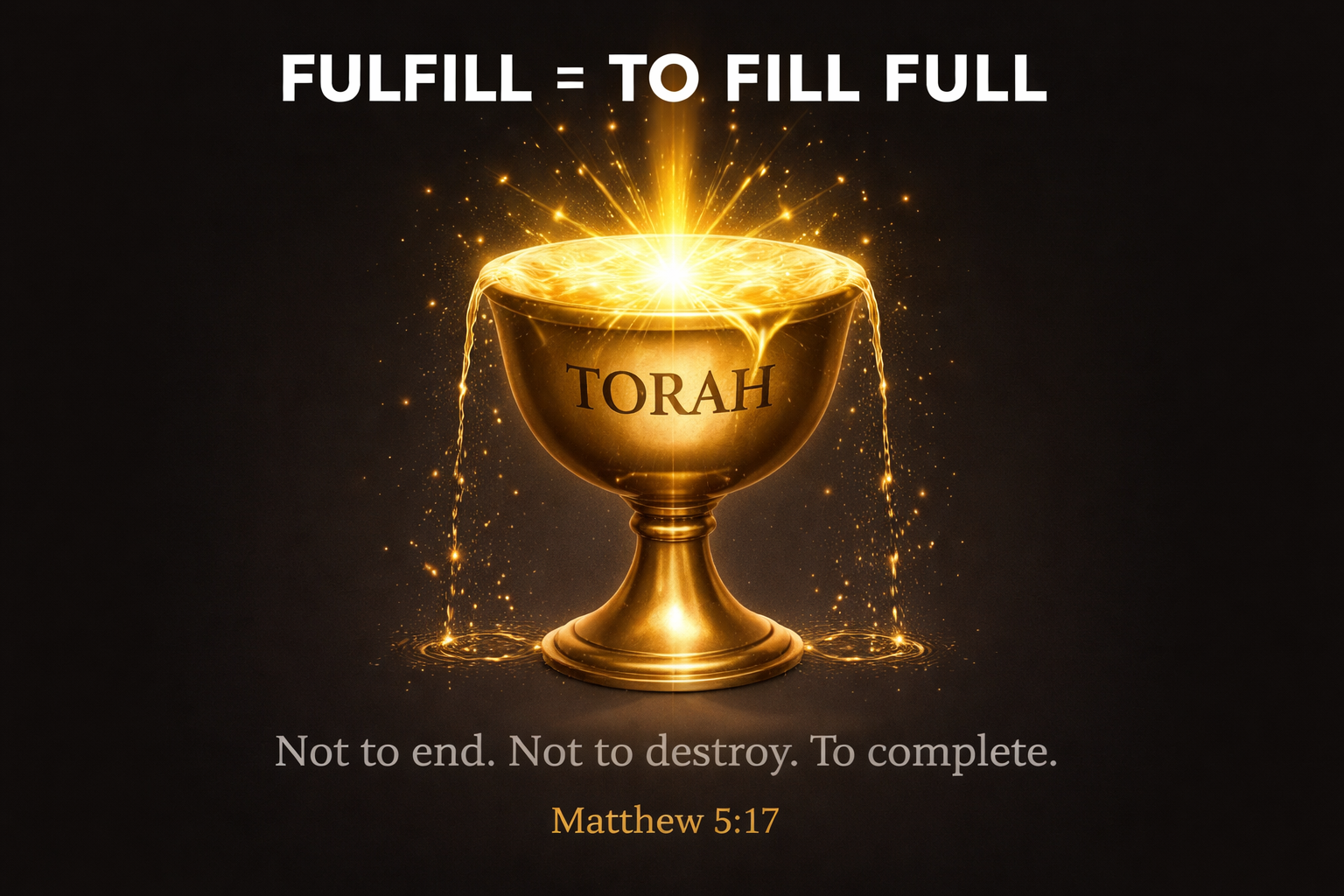
The Law Still Stands - Torah Is Still Binding Fulfill Means To Fill Full - Not To End

The Messiah Did Not Abolish the Law

"Think not that I am come to destroy the law, or the prophets: I am not come to destroy, but to fulfil. For verily I say unto you, Till heaven and earth pass, one jot or one tittle shall in no wise pass from the law, till all be fulfilled. Whosoever therefore shall break one of these least commandments, and shall teach men so, he shall be called the least in the kingdom of heaven: but whosoever shall do and teach them, the same shall be called great in the kingdom of heaven." Matthew 5:17-19

This is Yahusha speaking. Not Paul. Not a church father. The Messiah Himself. Let us examine His exact words.

The Logic of Matthew 5:17-19

1.
"Think not that I am come to destroy the law." He anticipated the lie that would come. He preemptively refuted it.
2.
"I am not come to destroy, but to fulfil." The Greek word pleroo means "to fill up, to make full, to complete." It does NOT mean "to end" or "to terminate." When you fill a cup, you do not destroy the cup. Yahusha filled the Torah with its fullest meaning.
3.
"Till heaven and earth pass." Look outside. Is heaven still there? Is earth still there? Then the Torah has not passed.
4.
"One jot or one tittle shall in no wise pass." Not even the smallest Hebrew letter (yod) or pen stroke (tittle) will be removed. Every detail stands.
5.
"Whosoever shall break... and shall teach men so... least in the kingdom." Teaching that Torah is abolished makes you least in the kingdom. These are the Messiah's words, not ours.

The "fulfill means end" argument is the foundation of lawless theology. But it contradicts the Messiah's own context. He said heaven and earth must pass first. Has that happened? Then the Torah stands. Period.

Sin Is the Transgression of the Law

"Whosoever committeth sin transgresseth also the law: for sin is the transgression of the law."
1 John 3:4
This is the biblical definition of sin. Not feelings. Not cultural norms. Transgression of Torah.
"And hereby we do know that we know him, if we keep his commandments. He that saith, I know him, and keepeth not his commandments, is a liar, and the truth is not in him."
1 John 2:3-4
Claiming to know Yahusha while rejecting His commandments = liar. John wrote this under inspiration of the Set-Apart Spirit.
"He that saith he abideth in him ought himself also so to walk, even as he walked."
1 John 2:6
How did Yahusha walk? In perfect Torah observance. If we claim to abide in Him, we walk the same way.

The Chain That Cannot Be Broken

1.
Sin = transgression of Torah (1 John 3:4)
2.
If Torah is abolished, there is no transgression. You cannot break a law that does not exist.
3.
If there is no transgression, there is no sin.
4.
If there is no sin, there is no need for a Savior.
5.
If there is no need for a Savior, there is no gospel.
6.
Abolishing Torah abolishes the entire plan of salvation. This is why the adversary fights so hard to convince people the law is done away with.

The Saints Keep the Commandments

The book of Revelation -- the final book of Scripture, written decades after the execution stake -- describes the end-times saints. How does it identify them? Not by their denomination. Not by their feelings. By two markers:

"Here is the patience of the saints: here are they that keep the commandments of Elohim, and the faith of Yahusha."
Revelation 14:12
Two marks of the saints: Commandments AND faith. Not faith alone. Not commandments alone. Both.
"And the dragon was wroth with the woman, and went to make war with the remnant of her seed, which keep the commandments of Elohim, and have the testimony of Yahusha the Messiah."
Revelation 12:17
The adversary makes war against those who keep commandments. Why would hasatan attack people keeping a law that was abolished? He attacks them because the law still stands.
"Blessed are they that do his commandments, that they may have right to the tree of life, and may enter in through the gates into the city."
Revelation 22:14
Access to the tree of life = keeping His commandments. This is the final chapter of the final book of the Bible.

If the commandments were abolished at the execution stake, why does the last book of the Bible -- written 60+ years later -- repeatedly identify the saints as commandment-keepers? The answer is obvious: the commandments were never abolished.

Paul Kept Torah

Paul is the most misquoted author in all of Scripture. Peter warned about this 2,000 years ago: "...in which are some things hard to be understood, which they that are unlearned and unstable wrest, as they do also the other scriptures, unto their own destruction" (2 Peter 3:16). Yet Paul's own actions and direct statements prove he never abandoned Torah.

"Take them, and purify thyself with them... and all may know that those things, whereof they were informed concerning thee, are nothing; but that thou thyself also walkest orderly, and keepest the law."
Acts 21:24
James and the elders in Jerusalem told Paul to demonstrate publicly that he kept the Torah -- to refute the FALSE rumor that he taught against it.
"But this I confess unto thee, that after the way which they call heresy, so worship I the Elohim of my fathers, believing all things which are written in the law and in the prophets."
Acts 24:14
Paul's own testimony: He believed and followed everything written in the Torah and the prophets.
"Neither against the law of the Yahudim, neither against the temple, nor yet against Caesar, have I offended any thing at all."
Acts 25:8
Paul under oath before Festus: He never sinned against the Torah. If he taught it was abolished, this statement is a lie.
"Do we then make void the law through faith? By no means: yea, we establish the law."
Romans 3:31
Faith does not void Torah. Faith ESTABLISHES Torah. Paul's own words.

The modern church reads Paul through a lawless lens and concludes he abolished Torah. But Paul himself said the opposite. He kept it. He defended it. He established it. The "anti-law Paul" is a fictional character created by misinterpretation.

Acts 15:21 -- The Verse Everyone Ignores

Acts 15 is one of the most misused chapters in the Bible. People claim the Jerusalem Council reduced Torah down to four rules for Gentile believers. But they always stop reading at verse 20. Verse 21 explains everything:

"For Moses of old time hath in every city them that preach him, being read in the synagogues every sabbath day."
Acts 15:21
THIS is the reason only four starting requirements were given. The new converts would learn the rest of Torah in the synagogues every Sabbath.

The four requirements in Acts 15:20 -- abstain from pollution of idols, fornication, things strangled, and blood -- were starting points, not the finish line. The council expected these new believers to attend synagogue on the Sabbath and progressively learn the full Torah of Moses.

This is like a university orientation. You don't hand a freshman the entire four-year curriculum on day one. You give them the essentials to start, and they learn the rest over time. Acts 15 is an onboarding process, not a reduction of Torah.

Notice also: they would learn Torah in the synagogues on every Sabbath day. Not Sunday. Sabbath. The early believers -- both Hebrew and Gentile -- were attending Sabbath synagogue services and learning Torah. This is the pattern of the first-century assembly.
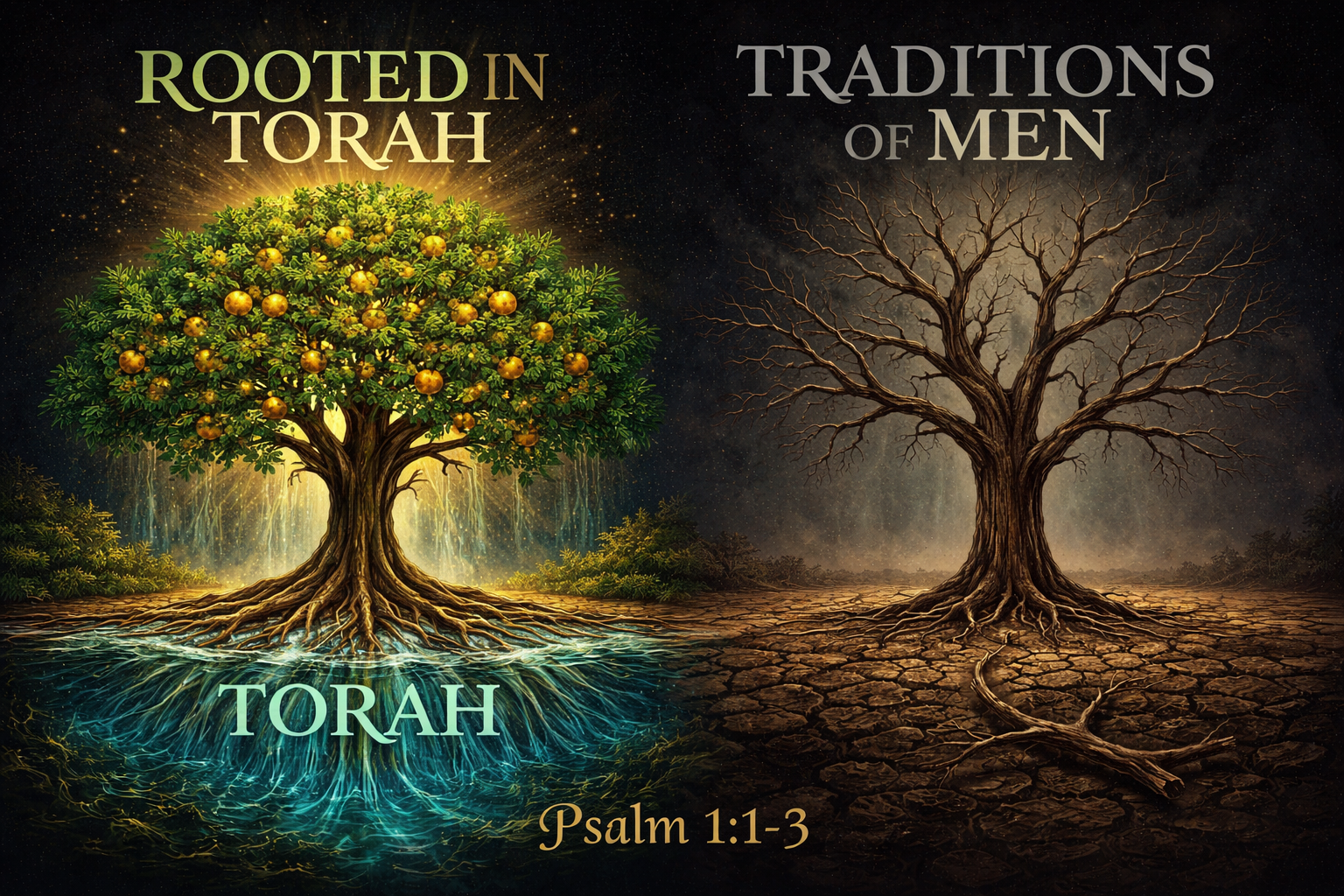
Rooted in Torah Bears Fruit - Traditions of Men Are Dead

Scripture Defines Fruit

Yahusha said, "By their fruits ye shall know them" (Matthew 7:20). But what is fruit? The modern church defines fruit as feelings, emotional experiences, church attendance, or social activism. But Scripture defines it very differently.

"Blessed is the man that walketh not in the counsel of the wicked, nor standeth in the way of sinners, nor sitteth in the seat of the scornful. But his delight is in the law of Yahuah; and in his law doth he meditate day and night. And he shall be like a tree planted by the rivers of water, that bringeth forth his fruit in his season."
Psalm 1:1-3
The fruitful tree is the one rooted in Torah. Delight in Torah = fruitfulness.
"Blessed is the man that trusteth in Yahuah... For he shall be as a tree planted by the waters... neither shall cease from yielding fruit."
Jeremiah 17:7-8
Same imagery. Trust in Yahuah + planted by His word = fruit. It is a Torah metaphor.
"If ye keep my commandments, ye shall abide in my love; even as I have kept my Father's commandments, and abide in his love."
John 15:10
Abiding = keeping commandments. Yahusha kept the Father's commandments. We keep His.
"Abide in me, and I in you. As the branch cannot bear fruit of itself, except it abide in the vine; no more can ye, except ye abide in me. I am the vine, ye are the branches: He that abideth in me, and I in him, the same bringeth forth much fruit."
John 15:4-5
Abiding in the Vine (Yahusha/Torah) = bearing fruit. Disconnected from Torah = no fruit.

Fruit is not feelings. Fruit is not church programs. Fruit is not emotional experiences during worship services. Fruit is the natural product of a life rooted in Torah obedience. The tree planted by waters of Torah brings forth fruit. The tree severed from Torah withers. This is Scripture's own definition.
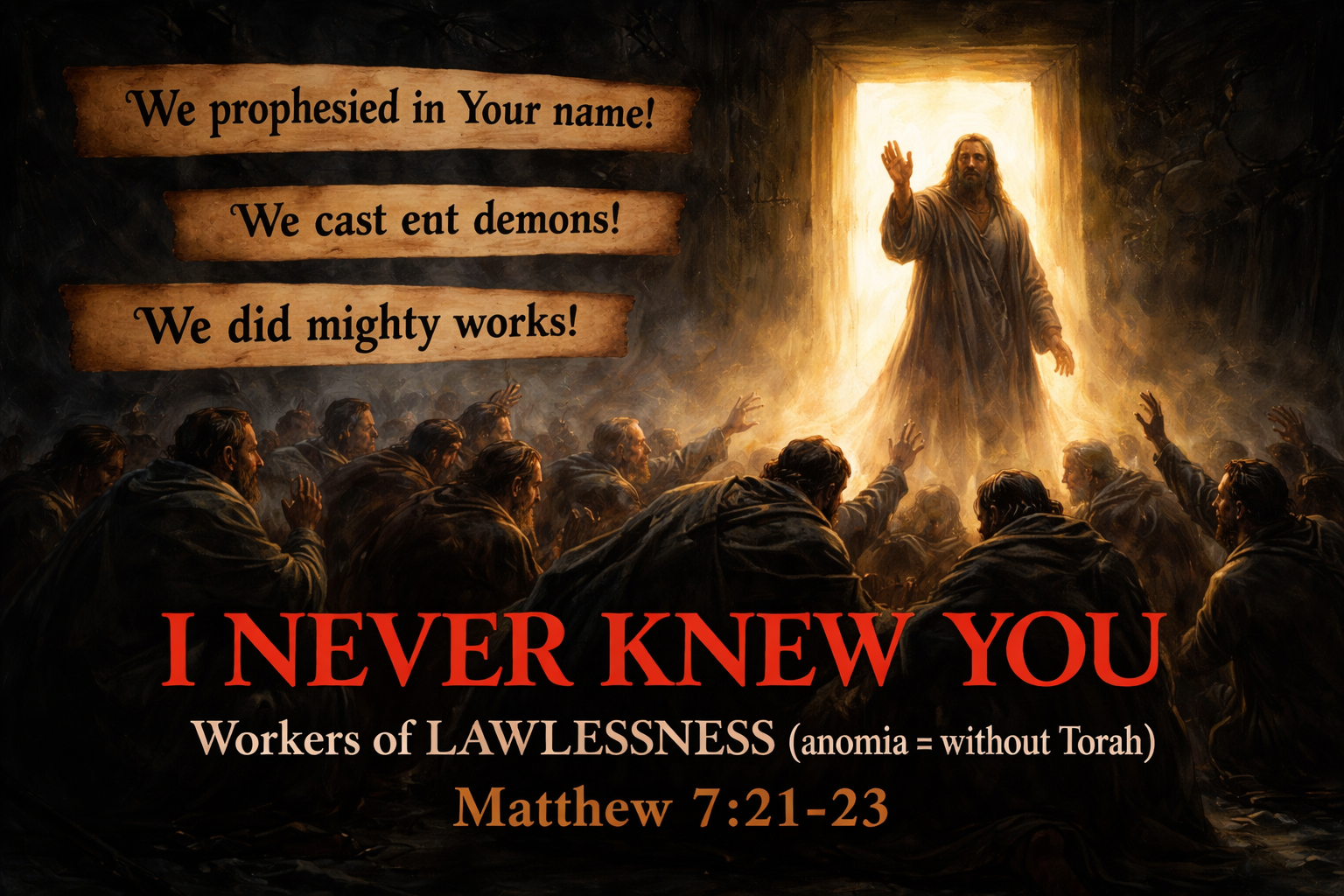
I Never Knew You - Workers of Lawlessness

"I Never Knew You"

The Most Terrifying Passage in Scripture

"Not every one that saith unto me, Master, Master, shall enter into the kingdom of heaven; but he that doeth the will of my Father which is in heaven. Many will say to me in that day, Master, Master, have we not prophesied in thy name? and in thy name have cast out devils? and in thy name done many wonderful works? And then will I profess unto them, I never knew you: depart from me, ye that work iniquity." Matthew 7:21-23

Read it again slowly. These people are not atheists. They are not pagans. They are people who call Yahusha "Master." They prophesied in His name. They cast out demons in His name. They did "many wonderful works" in His name. By every modern church standard, these are successful, Spirit-filled believers.

And He says: "I never knew you."

The Greek word translated "iniquity" is anomia -- literally "without Torah" (a = without, nomia = law). He is not rejecting them for lack of faith. He is rejecting them for lawlessness -- for living without Torah.

The Diagnostic Test

How do you know if you truly know Him? Scripture gives us the diagnostic:

"And hereby we do know that we know him, if we keep his commandments. He that saith, I know him, and keepeth not his commandments, is a liar, and the truth is not in him."
1 John 2:3-4
This is not ambiguous. Keep commandments = know Him. Reject commandments = liar.
"Whosoever committeth sin transgresseth also the law... And ye know that he was manifested to take away our sins... Whosoever abideth in him sinneth not: whosoever sinneth hath not seen him, neither known him."
1 John 3:4-6
Sin = breaking Torah. Abiding in Him = not breaking Torah. Those who practice Torah-breaking have not known Him.
"Be ye not unequally yoked together with unbelievers: for what fellowship hath righteousness with unrighteousness? and what communion hath light with darkness?"
2 Corinthians 6:14
Righteousness = Torah obedience (Psalm 119:172). Unrighteousness = Torah-breaking. They cannot fellowship.
"But the fearful, and unbelieving, and the abominable, and murderers, and whoremongers, and sorcerers, and idolaters, and all liars, shall have their part in the lake which burneth with fire and brimstone."
Revelation 21:8
All liars. If you say "I know Him" but keep not His commandments, you are a liar (1 John 2:4). Connect the dots.

The Broad Road IS the Church

Yahusha said, "Enter ye in at the strait gate: for wide is the gate, and broad is the way, that leadeth to destruction, and many there be which go in thereat" (Matthew 7:13).

Who are the "many"? In Matthew 7:22, Yahusha says: "Many will say to me in that day, Master, Master..."

The "many" on the broad road are not atheists. They are not people who reject the Messiah. They are people who call Him "Master" but live in anomia -- lawlessness. They are the mainstream church -- billions of people who claim His name but reject His Torah.

The narrow gate is Torah obedience through faith in Yahusha. That is why it is narrow. That is why few find it.