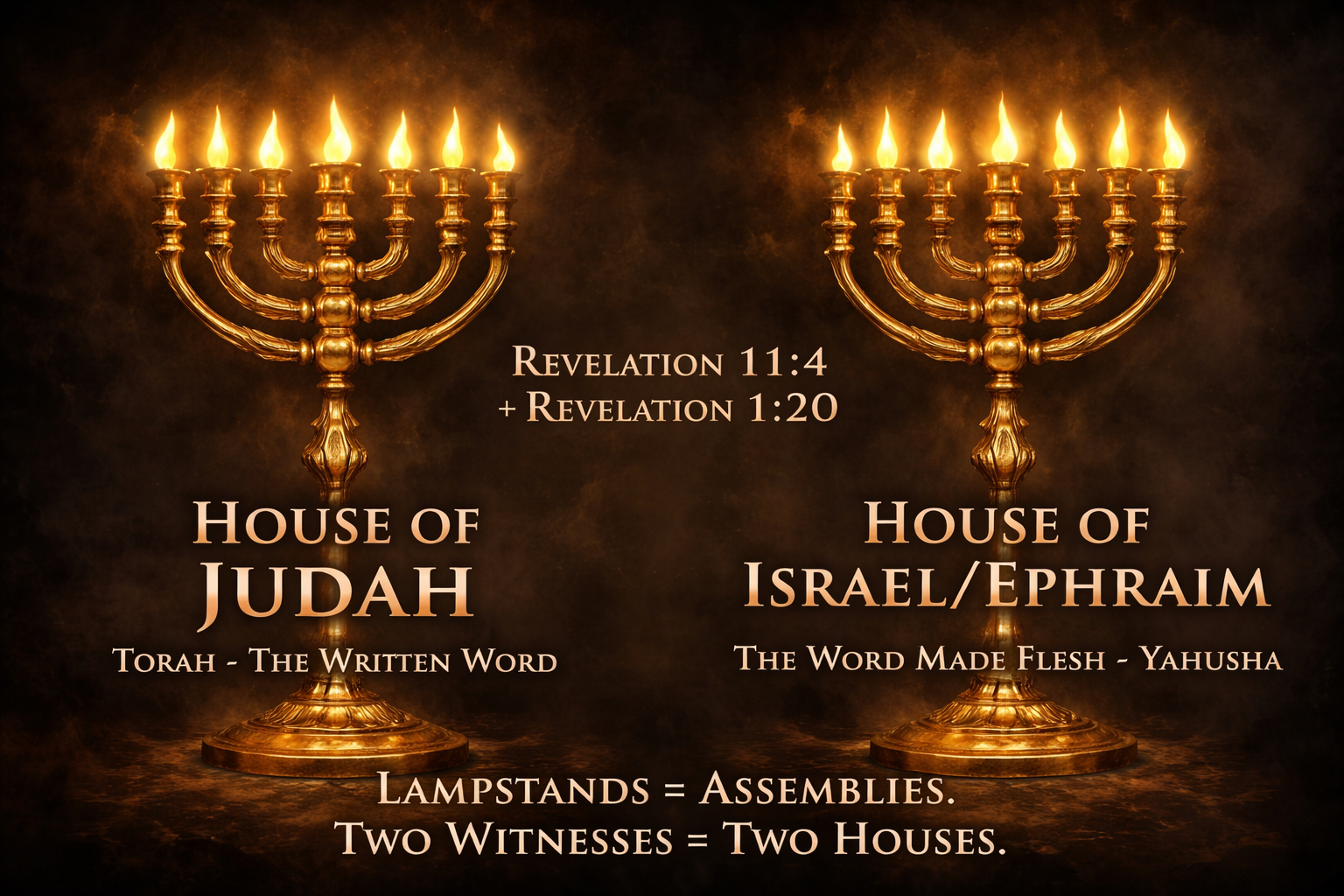
Scripture interprets itself. Lampstands are assemblies. The two witnesses are not two literal men.
The identity of the two witnesses is not a mystery — unless you ignore how Scripture defines its own symbols. Revelation tells you exactly what the two witnesses are. Two lampstands. And Revelation tells you exactly what lampstands represent. Assemblies.
This is not interpretation. This is reading.
"These are the two olive trees, and the two candlesticks standing before the Elohim of the earth."
Revelation 11:4
The two witnesses are identified as two lampstands (candlesticks). Scripture defines its own symbols.
"The mystery of the seven stars which thou sawest in my right hand, and the seven golden candlesticks. The seven stars are the angels of the seven assemblies: and the seven candlesticks which thou sawest are the seven assemblies."
Revelation 1:20
Lampstands = assemblies. This is not a guess. Yahusha Himself defines this symbol. Two lampstands = two assemblies = two houses of Israel.
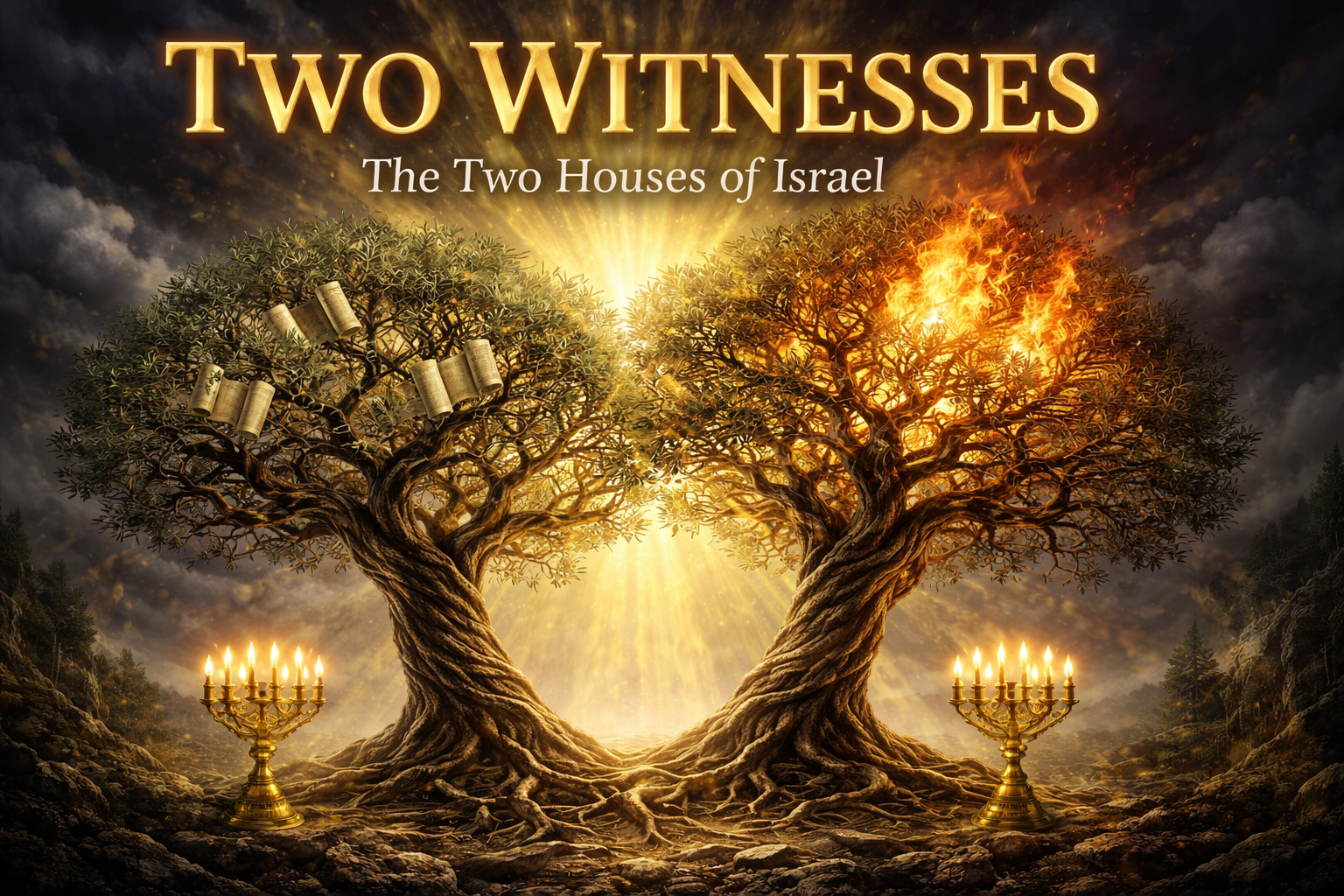
After the death of King Solomon, Israel was divided into two kingdoms: the southern kingdom of Judah (Judah and Benjamin) and the northern kingdom of Israel/Ephraim (the ten tribes). These two houses were scattered, prophesied to be reunited, and serve as Yahuah's witnesses throughout history.
"Then he said unto me, These are the two anointed ones, that stand by the Master of the whole earth."
Zechariah 4:14
Zechariah's vision of two olive trees parallels Revelation 11:4 exactly. Two anointed witnesses standing before the Most High.
"Ye are my witnesses, saith Yahuah, and my servant whom I have chosen."
Isaiah 43:10
Yahuah identifies all of Israel as His witnesses. The two houses of Israel are the two witnesses.
"The word of Yahuah came again unto me, saying, Moreover, thou son of man, take thee one stick, and write upon it, For Judah... then take another stick, and write upon it, For Joseph, the stick of Ephraim... and they shall become one in thine hand."
Ezekiel 37:15-19
Two sticks. Two houses. One future reunification. Judah and Ephraim — the two witnesses of Yahuah.
"And if by grace, then is it no more of works... I say then, Hath Elohim cast away his people? By no means... Even so then at this present time also there is a remnant according to the election of grace... And so all Israel shall be saved."
Romans 11:5-6, 26
Paul confirms that both houses will ultimately be restored. The olive tree of Romans 11 connects directly to the two olive trees of Zechariah 4 and Revelation 11.
| Attribute | First Witness: Judah | Second Witness: Israel/Ephraim |
|---|---|---|
| Kingdom | Southern Kingdom | Northern Kingdom (Ten Tribes) |
| Testimony | Torah — the written covenant | The Word made flesh — the living testimony |
| Symbol | Olive tree / lampstand | Olive tree / lampstand |
| Represented by | Moses (Torah / the Law) | Elijah (the Prophets) |
| Scattered | Babylonian exile, 70 AD destruction | Assyrian exile, scattered among nations |
| Prophesied reunion | Ezekiel 37:15-22 — the two sticks become one | |
The powers described in Revelation 11 match Moses and Elijah exactly. This is not coincidence. Moses and Elijah represent the two great divisions of Old Testament Scripture: the Torah (the Law) and the Prophets. They appeared together at the Transfiguration with Yahusha, and Malachi closes the Old Testament by invoking both.
"And, behold, there appeared unto them Moses and Elijah talking with him."
Matthew 17:3 (The Transfiguration)
Moses (Torah) and Elijah (Prophets) appeared with the Messiah. The two witnesses standing with the Living Word. Torah, Prophets, and Messiah — the complete testimony.
"These have power to shut heaven, that it rain not in the days of their prophecy: and have power over waters to turn them to blood, and to smite the earth with all plagues."
Revelation 11:6
Shutting heaven so it rains not = Elijah (1 Kings 17:1). Turning water to blood and sending plagues = Moses (Exodus 7:17-20). The powers match perfectly.
"Remember ye the law of Moses my servant, which I commanded unto him in Horeb for all Israel... Behold, I will send you Elijah the prophet before the coming of the great and dreadful day of Yahuah."
Malachi 4:4-5
The very last words of the Old Testament prophets invoke Moses and Elijah — Torah and Prophets — the two witnesses that endure until the end.
The two witnesses prophesy for 1,260 days clothed in sackcloth. This is the same 1,260-year period as the beast's reign in Revelation 13:5 (42 months = 1,260 days, using the year-day principle). This is no coincidence. The same period that the beast has power is the same period the witnesses prophesy in mourning.
"And I will give power unto my two witnesses, and they shall prophesy a thousand two hundred and threescore days, clothed in sackcloth."
Revelation 11:3
1,260 prophetic days = 1,260 literal years. From 538 AD to 1798 AD. The same period as papal supremacy.
There is only one place in all of Scripture where people "make merry" and "send gifts to one another." It is not a celebration of the Messiah. It is a celebration of the death of the two witnesses.
"And they that dwell upon the earth shall rejoice over them, and make merry, and shall send gifts one to another; because these two prophets tormented them that dwelt on the earth."
Revelation 11:10
This is the ONLY verse in the entire Bible where people "make merry" and "send gifts to one another." Think about that. Where in modern culture do people make merry and exchange gifts?
The world does not celebrate Torah. The world does not celebrate the Prophets. The world celebrates their perceived defeat. When the two witnesses (Torah and Prophets — the two houses of Israel) are considered "dead" — when their testimony is silenced, when the law is declared abolished, when the prophets are dismissed — the earth dwellers rejoice.
They make merry. They send gifts. They feast.
Christmas is a celebration rooted in pagan Saturnalia, grafted onto the Messiah's name, that replaces Torah obedience with gift-giving and replaces prophetic truth with sentiment. It celebrates the very thing Revelation warns about: the perceived death of the witnesses.
The witnesses "tormented" the earth dwellers. How? By declaring the Torah still valid. By proclaiming repentance. By calling out sin. When you silence those voices, the party begins.
Read Revelation 11:10 again. Then look at December 25th. Scripture interprets itself.