The Serpent's Seed and the Abyss
The fallen ones are imprisoned in the deep. The waters under the earth hold them in chains of darkness.
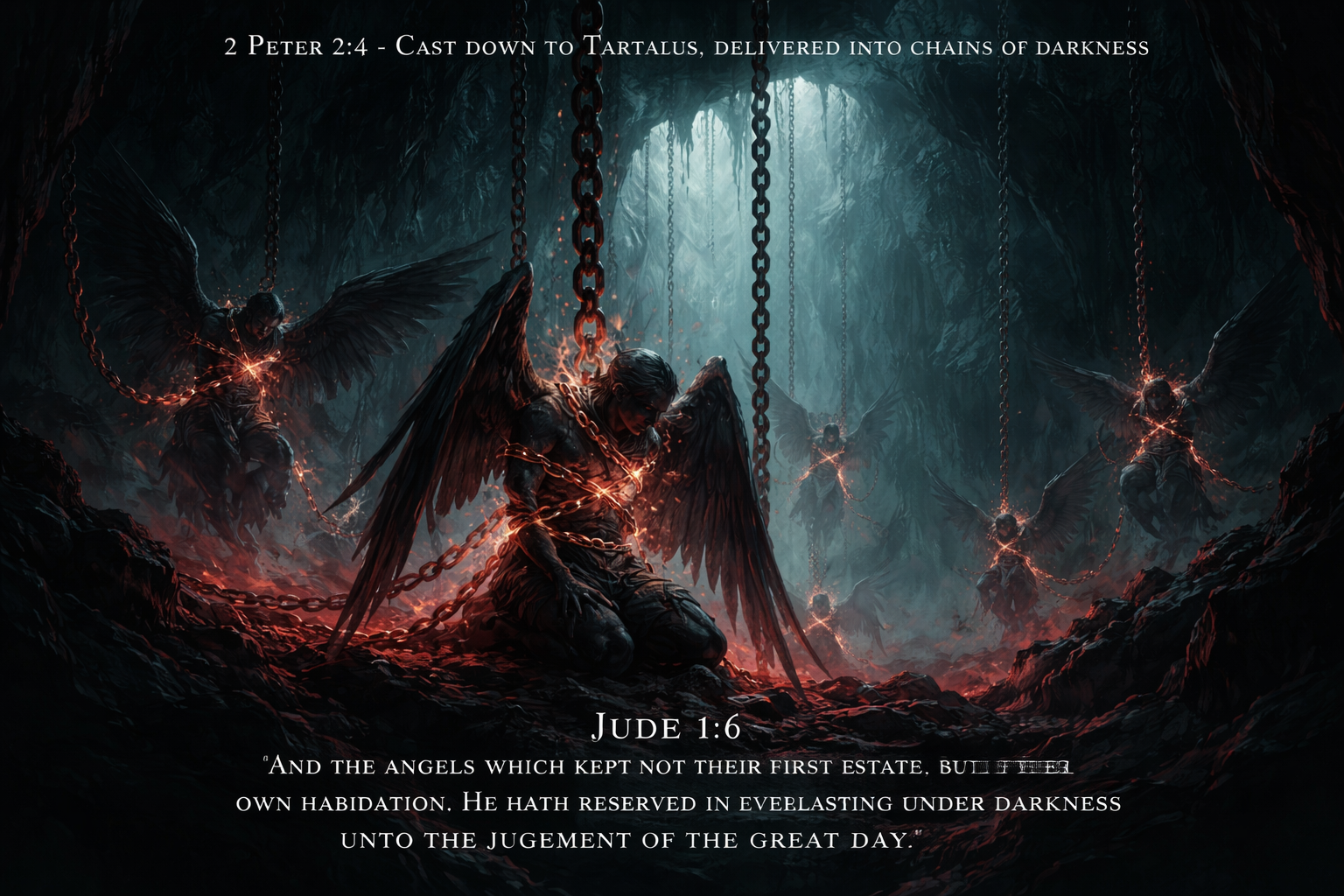
The fallen ones are imprisoned in the deep. The waters under the earth hold them in chains of darkness.
Before there was a nation. Before there was a covenant. Before there was Torah written on stone. There was this — the first prophecy ever spoken:
"And I will put enmity between thee and the woman, and between thy seed and her Seed; it shall bruise thy head, and thou shalt bruise his heel." Genesis 3:15
This is the verse that defines all of history. Two seeds. Two lineages. Two kingdoms set against each other from the beginning. The serpent has a seed. The woman has a Seed. The enmity between them is not figurative — it is war. A war that started in the garden and will not end until the final judgment.
The serpent's seed would bruise the heel of the woman's Seed. The woman's Seed — Yahusha HaMashiach — would crush the serpent's head. The bruised heel is the stake. The crushed head is the final destruction. But between those two events lies the entire span of human history, and the war has never stopped.
The question is: what is the serpent's seed? Genesis 6 provides the answer.
"And it came to pass, when men began to multiply on the face of the earth, and daughters were born unto them, That the sons of Elohim saw the daughters of men that they were fair; and they took them wives of all which they chose." Genesis 6:1-2
"There were Nephilim in the earth in those days; and also after that, when the sons of Elohim came in unto the daughters of men, and they bare children to them, the same became mighty men which were of old, men of renown." Genesis 6:4
The sons of Elohim came in to the daughters of men. The term b'nei ha'elohim — sons of Elohim — in the Hebrew text of the Old Testament refers consistently to angelic beings (Job 1:6, Job 2:1, Job 38:7). These were not human men. These were fallen watchers. Angelic beings who abandoned their created role and violated the boundary between heaven and earth.
The offspring were Nephilim — giants, mighty ones, men of renown. This was not a natural union. It was a violation of the created order. An abomination that corrupted the bloodline of humanity and provoked Yahuah to send the Flood.
This is the serpent's seed made manifest. The enemy's strategy was to corrupt all flesh, to pollute the human line so thoroughly that the promised Seed of the woman could never come. The Flood was Yahuah's response — a judgment that wiped the corruption from the earth and preserved the one family whose bloodline remained intact: Noah, who was "perfect in his generations" (Genesis 6:9).
What happened to the angels who committed this transgression? Peter tells us plainly:
"For if Elohim did not spare the angels who sinned, but cast them down to Tartarus, and delivered them into chains of darkness, to be reserved for judgment..."
2 Peter 2:4
The Greek word used here is tartaroo — the only time it appears in all of Scripture. Tartarus was understood as the deepest pit, lower than Hades, a prison beneath the abyss itself. Peter chose this word deliberately. These angels were not simply cast out of heaven. They were cast down — into the lowest depth, into the deep, into the abyss.
They sinned. They were not spared. They were imprisoned. The chains are not metaphorical — they are chains of darkness. Darkness so complete that it functions as a prison. They wait there now, held until the day of judgment. Not free. Not roaming. Chained in the deep.
Jude confirms and expands what Peter recorded:
"And the angels which kept not their first estate, but left their own habitation, He hath reserved in everlasting chains under darkness unto the judgment of the great day." Jude 1:6
Two witnesses. Peter and Jude, independently, record the same event with the same details. The angels kept not their first estate — they abandoned their appointed position in the heavenly order. They left their own habitation — they departed from their proper domain, their spiritual bodies, and took on flesh to mingle with women.
The punishment is precise: everlasting chains under darkness. Not temporary. Not conditional. Everlasting. They are imprisoned below, in the deep, in the tehom, in the waters under the earth. The same primordial deep that existed before creation — "and darkness was upon the face of the deep" (Genesis 1:2) — serves as their prison.
They left their proper domain. They are now imprisoned below. They wait for judgment. The great day has not yet come. But it will.
Now draw the line from beginning to end:
This connects directly to the teaching on The Sea Is the Abyss. The tehom — the primordial deep, the waters under the earth — is the prison of the fallen watchers. When Genesis 1:2 says "darkness was upon the face of the deep," it is describing a realm that already existed before Yahuah spoke light into being. That darkness now serves as chains.
When Revelation speaks of things rising from the abyss (Revelation 9:1-2, 11:7, 17:8), it speaks of this realm. The bottomless pit. The deep. The prison beneath the waters. The place where the serpent's seed — the fallen watchers and their offspring — are held in chains of darkness, reserved for judgment.
"And the fifth angel sounded, and I saw a star fall from heaven unto the earth: and to him was given the key of the bottomless pit. And he opened the bottomless pit; and there arose a smoke out of the pit, as the smoke of a great furnace." Revelation 9:1-2
The pit has a key. The pit can be opened. What is imprisoned there will one day be released — but only according to the sovereign timeline of Yahuah. The serpent's seed is not defeated merely by being imprisoned. The final crushing of the serpent's head — promised in Genesis 3:15 — is fulfilled when the Messiah returns, when the enemy is cast into the lake of fire, and when the abyss gives up everything it holds for the final judgment.
The first prophecy is also the last prophecy. The war between the seeds ends where it began — with the complete and total victory of the woman's Seed over the serpent and all his offspring.